





Our Easiest Animals to Draw Step-by-Step (Great for Beginners!)
Below are 11 step-by-step animal drawing tutorials for beginners. You can watch the video tutorial and follow along, pausing after each step to follow at your own pace. Or you can click through to the article, which has each step broken down into an individual image, with new pencil lines shown in red, and an explanation of what to draw.
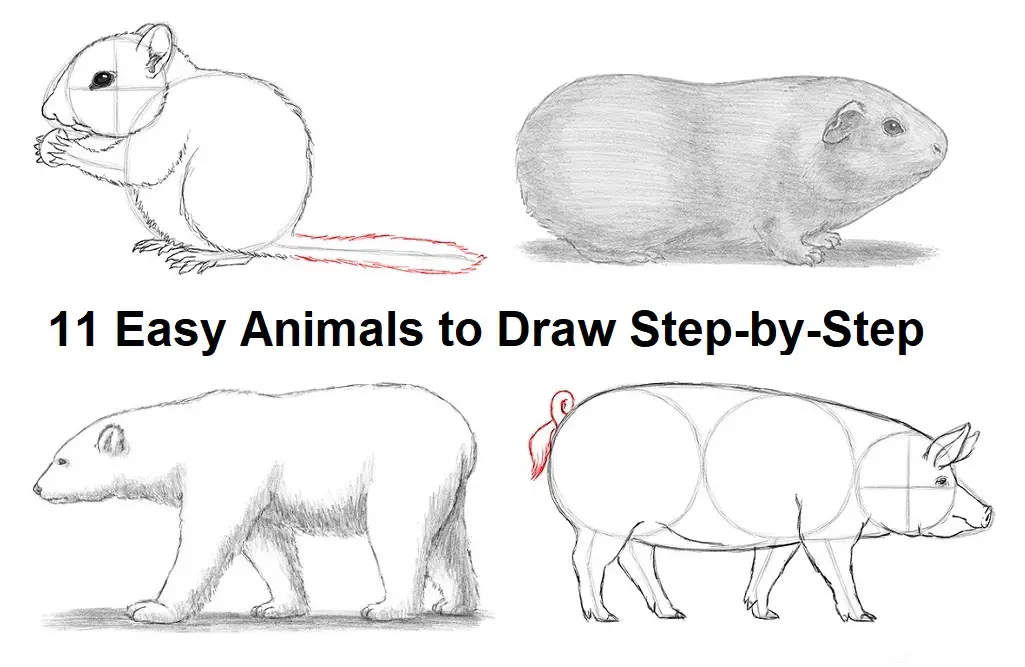
In this list of easy animal drawings for beginners, you'll find a lot of birds because they are shown from the side, so you don't need to worry about perspective, and you only need to draw one eye. And because birds only have two legs, they are immediately easier to draw than four-legged animals! But don't worry--there are a few mammals and a fish sprinkled throughout this list too.
There are a few things to note before you begin:
- If these drawing tutorials are still too advanced for you, you can practice drawing cartoon animals and try these again once you're more comfortable. Keep practicing!
- Make sure you can draw a pretty good circle so you can create good guidelines. Here is an article showing four different techniques for drawing a perfect circle.
- Try out these shading exercises if you're not familiar with how to shade yet.
- Finally, HAVE FUN! Even if your drawing doesn't turn out perfect, you should still have fun drawing.
Grab your pencil and paper, and let's get drawing! If you're curious, check out what art supplies I use for drawing.
1. How to Draw a Mallard Duck
Fun fact: Mallards can fly up to 55 miles per hour!
Find the duck's written step-by-step drawing tutorial here.
2. How to Draw a Polar Bear
Fun fact: Unlike black and brown bears, polar bears do not hibernate.
Find the polar bear's written step-by-step drawing tutorial here.
3. How to Draw a Cardinal Bird
Fun fact: The cardinal is the official bird of seven U.S. states.
Find the cardinal's written step-by-step drawing tutorial here. There is also a cartoon cardinal drawing tutorial!
4. How to Draw a Pig
Fun fact: Scientists believe pigs are the smartest domesticated animal--even smarter than dogs!
Find the pig's written step-by-step drawing tutorial here. You can also draw a cartoon pig if you'd like.
5. How to Draw a Guinea Pig
Fun fact: When a guinea pig is happy, it will jump straight up in the air. This is called "popcorning."
Find the guinea pig written step-by-step drawing tutorial here.
6. How to Draw a Snowy Owl
Fun fact: The snowy owl is the largest owl in North America. It is one of the species available at Eeylops Owl Emporium on Diagon Alley, where Harry Potter's snowy owl, Hedwig, came from!
Find the snowy owl's written step-by-step drawing tutorial here.
7. How to Draw a Chicken (Hen)
Fun fact: There are 25 billion chickens in the world, so there are more of them than any other bird species.
Find the chicken's written step-by-step drawing tutorial here. And you can draw a cartoon rooster too!
8. How to Draw a Piranha Fish
Fun fact: After Teddy Roosevelt traveled to South America in 1913, he wrote in his book, Through the Brazilian Wilderness, that he saw a pack of piranhas eat an entire cow carcass that had been thrown into the river. This is probably what kicked off the piranha's bad reputation in the United States.
Find the piranha's written step-by-step drawing tutorial here.
9. How to Draw a House Sparrow
Fun fact: Even though house sparrows are found all over North America today, they are not a native species. Birds from England were first introduced in 1852 when they were released in New York City to control the linden moth.
Find the house sparrow's written step-by-step drawing tutorial here.
10. How to Draw a Kiwi Bird
Fun fact: Kiwi are the only birds with nostrils at the end of their long beaks. This allows them to locate insects and worms underground with their sense of smell, rather than touch or taste.
Find the kiwi bird's written step-by-step drawing tutorial here.
11. How to Draw a Chipmunk
Fun fact: The chipmunk genus name Tamias is Greek for "treasurer," "steward" or "housekeeper," which refers to their habit of collecting and storing food for winter use.
Find the chipmunk's written step-by-step drawing tutorial here.